
What Is an ERP and Why Does Your Business Need One?
What Is an ERP and Why Does Your Business Need One?
As a business grows, managing daily operations becomes increasingly complex. Customer information may be stored in one system, invoices in another, inventory in spreadsheets, and sales activities somewhere else.
This fragmentation can lead to duplicated work, errors, lost information, and difficulty understanding what is really happening inside the business.
This is where an ERP system can help.
What Is an ERP?
ERP stands for Enterprise Resource Planning.
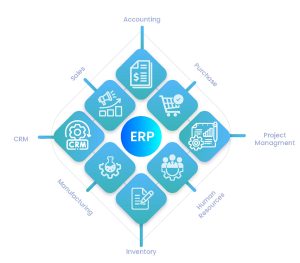
An ERP is a software system that brings different business operations together on a single platform.
Instead of using separate applications for every department, an ERP allows information to flow between areas such as:
- Sales
- CRM
- Accounting
- Inventory
- Purchasing
- Manufacturing
- Human Resources
- Project Management
- eCommerce
- Customer Service
The main objective is simple: centralize business information and make processes work together.
A Simple Example
Imagine a company receives an order from a customer.
Without an ERP, an employee might receive the order by email, enter it into a spreadsheet, send information to accounting, contact the warehouse to verify inventory, and manually prepare an invoice.
Several people may need to enter the same information into different systems.
With an ERP, the process can be connected.
A confirmed sales order can automatically update inventory, generate delivery operations, prepare an invoice, update the customer’s account, and provide management with updated sales information.
One action can trigger an entire business workflow.
Why Do Businesses Use ERP Systems?
1. Centralized Information
One of the biggest advantages of an ERP is having a single source of information.
Employees don’t have to search through multiple spreadsheets, emails, and applications to find what they need.
Sales, accounting, inventory, and other departments can work with the same data.
2. Less Manual Work
Many repetitive operations can be automated.
For example, an ERP can automatically generate invoices, update inventory quantities, create purchase orders, send notifications, calculate taxes, or generate reports.
This allows employees to spend less time entering data and more time on valuable work.
3. Better Visibility
When information is scattered across different systems, understanding business performance can be difficult.
ERP systems provide reports and dashboards that help managers monitor sales, expenses, inventory, profitability, customer activity, and other important indicators.
Better information can lead to better decisions.
4. Fewer Errors
Entering the same information manually into several systems increases the possibility of mistakes.
By connecting processes and sharing information between departments, an ERP reduces duplicate data entry and helps improve data consistency.
5. Easier Growth
Processes that work for a company with five employees may become difficult to manage when the company grows to 20, 50, or 100 employees.
A properly implemented ERP provides a structured foundation that can evolve with the organization.
ERP Doesn’t Mean One-Size-Fits-All
Every business has different processes.
A manufacturing company does not operate like a consulting company, and an eCommerce business has different requirements from a construction company.
For this reason, selecting an ERP is only part of the process.
Configuration, customization, integration, and implementation are equally important.
Modern ERP platforms such as Odoo provide a large number of standard applications while also allowing businesses to customize workflows and develop additional functionality when necessary.
How Do You Know If Your Business Needs an ERP?
Your company may benefit from an ERP if:
- Employees rely heavily on spreadsheets.
- The same information is entered several times.
- Departments use systems that don’t communicate with each other.
- Inventory is difficult to track accurately.
- Preparing reports takes too much time.
- Business processes depend heavily on manual operations.
- Management lacks real-time visibility into operations.
- Your current software no longer supports the company’s growth.
You don’t necessarily need to experience all of these problems. Even a few can indicate that your current systems are creating unnecessary complexity.
Choosing the Right ERP
The best ERP isn’t necessarily the system with the largest number of features.
It’s the system that fits your business processes, budget, objectives, and future growth.
Before implementing an ERP, businesses should first understand their existing workflows, identify inefficiencies, determine which processes should be automated, and clearly define what they expect from the new system.
Technology should adapt to the business — not force the business into unnecessary complexity.
Final Thoughts
An ERP is more than accounting or inventory software.
When implemented correctly, it becomes the digital foundation connecting different parts of a company.
The goal isn’t simply to replace spreadsheets or install new software. The real goal is to simplify operations, improve visibility, reduce repetitive work, and give businesses better control over their processes.
As companies continue to digitalize their operations, integrated systems and automation will play an increasingly important role in how efficiently they can grow.